Fuel Surcharge FSC Hits $5.38
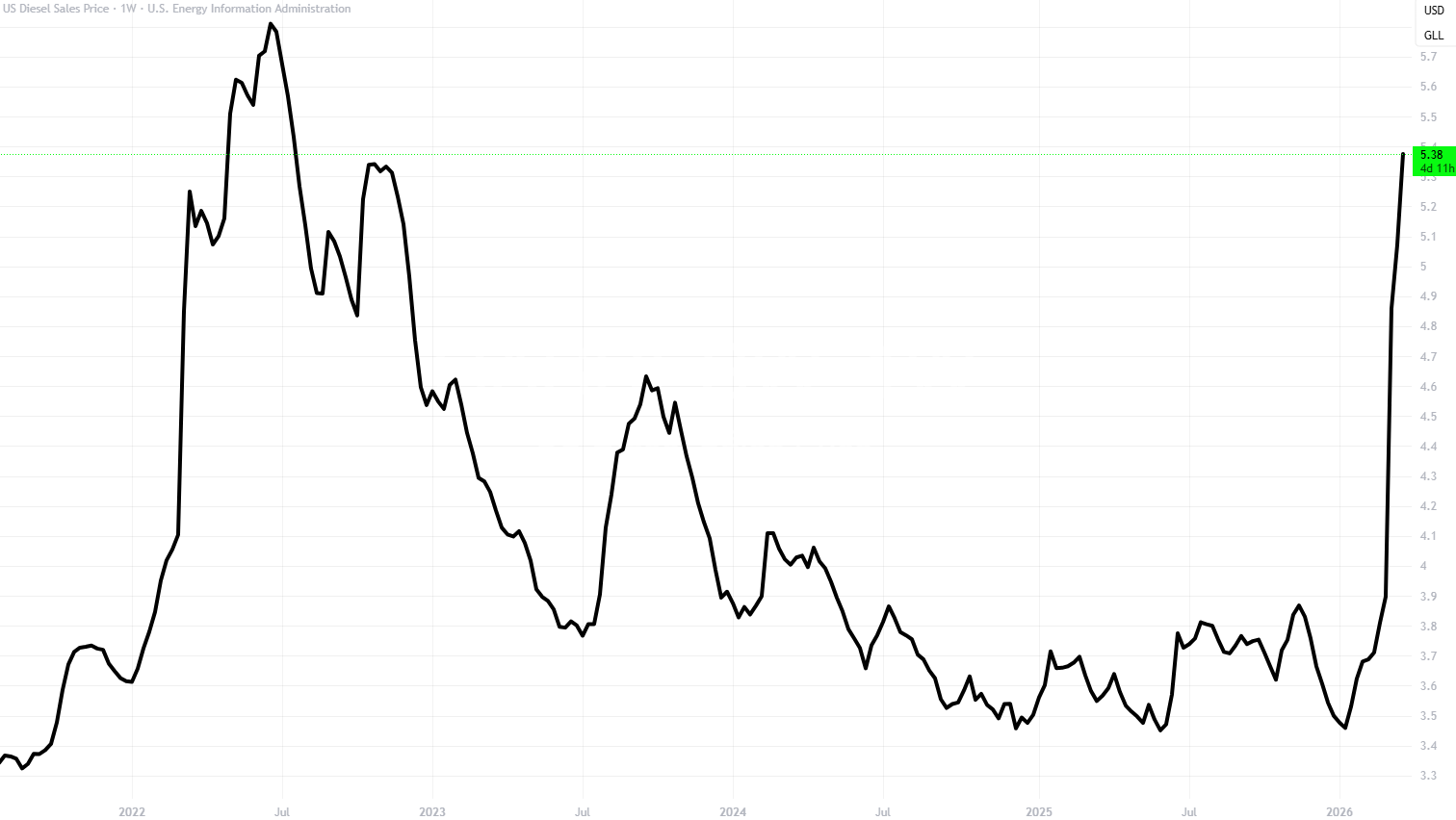
The current FSC rate at every major motor carrier now reflects diesel at $5.38 per gallon, driven directly by the Iran war and the near-closure of the Strait of Hormuz. This week's freight FSC charges are not an anomaly. They are the new baseline, unless shippers act. Here is exactly what is happening, what you are paying, and what TLI does about it.
What Is a Fuel Surcharge (FSC) and How Does It Impact Your Freight Bill?
A
fuel surcharge, universally abbreviated as FSC,
is the variable fee that every motor carrier tacks onto your base freight rate to recover the cost of diesel. Unlike your negotiated linehaul rate, which stays fixed until you renegotiate it, the fuel surcharge floats. It resets every single week, tied directly to the
U.S. Department of Energy (DOE) national average on-highway diesel price. That means every time diesel moves, your
freight FSC moves with it, automatically, on every shipment, with no advance notice required.
At $5.38 per gallon, today's diesel prices push the current FSC rate at major LTL carriers into the 43–51.1% range. That is not a small line item. On a $1,000 base freight charge, you are writing a check for an additional $430–$511 in FSC charges in shipping alone, before a single accessorial fee touches your invoice. At scale, across hundreds or thousands of shipments per year, FSC freight charges become one of the largest, most volatile, and least-scrutinized costs in a shipper's P&L. A major problem is many shippers do not realize there are actions that can be taken to mitigate the fuel cost.
How Motor Carriers Calculate FSC Freight Charges
Calculating the FSC Charge
To calculate a motor carrier’s fuel surcharge (FSC), start with the weekly diesel price published by the U.S. Department of Energy (DOE). Most national carriers use the DOE national average diesel price, while regional carriers may use the DOE average for their specific region.
Next, find the carrier’s fuel surcharge table (linked below). Look for the diesel price range that matches the current DOE average. The percentage listed in that range is the fuel surcharge rate. Multiply that percentage by the shipment’s linehaul charge. Add the fuel surcharge to the linehaul to get your transportation subtotal.
Then add any accessorial charges, such as liftgate service, residential delivery, or detention, to calculate the total invoice amount.
Our rating system in
ViewPoint TMS does this automatically. They also factor in base tariff rates, negotiated discounts, accessorial rules, and contract terms. Even so, the basic fuel surcharge process is generally consistent across most carriers and works the same way for most shippers.
Motor Carrier Fuel Surcharge FSC Table:
Why the Iran War Drove Fuel Surcharges to Their Highest Levels Since 2022
The Hormuz closure did not just disrupt one shipping lane. It removed roughly 20 million barrels per day of Gulf oil exports from world markets. Brent crude, which opened 2026 near $70 per barrel, ripped past $100 within days of the conflict starting and has traded between $100 and $120 since. That move in crude oil translates almost directly into a move at the diesel pump, and directly into a move in the
current FSC rate that every shipper pays this week.
The ripple effects now extend across every major freight mode:
CMA CGM has resumed Middle East bookings via the Red Sea as port congestion eases across Asia, but carriers are absorbing rerouting premiums and passing them through in spot rates. China to North America East Coast is already up +4% week on week basis.
South Asia to Europe air cargo rates have surged 25% week over week as carriers scramble to reroute around crippled Middle Eastern hubs, with air FSC charges nearly doubling on key corridors.
Trans-Atlantic Trucking & Ocean
Carriers are removing ships and port calls from trans-Atlantic services, tightening capacity in that market significantly, a dynamic that Journal of Commerce reporting confirms is already affecting shipper options
The diesel price spike hit U.S. trucking immediately through the automated FSC table mechanism, pushing freight FSC charges to levels not seen since late 2022
Why This Fuel Surcharge Cycle Feels Different Than 2022
The Hidden Truth: FSC Has Become a Carrier Profit Center
Here is what most shippers never learn: a fuel surcharge was never designed to be a profit center. Carriers created FSC tables in an era when diesel cost under $3 per gallon, calibrating the percentage steps to recover actual fuel cost increases — nothing more. But the same tables that were built for a $3/gallon world now generate excess margin at $5/gallon. The percentage steps did not scale proportionally to actual fleet cost increases as diesel rose.
The
TD Cowen research documented exactly this dynamic during the 2022 diesel spike. Among major LTL carriers, the average fuel surcharge climbed from 28.3% in Q4 2021 to 42.1% in March 2022 — a 49% jump in a matter of months. That surge did not represent a 49% increase in carrier fuel costs. It represented a 49% increase in what shippers paid through a tariff table that carriers had no incentive to recalibrate downward.
How TLI Delivers Significantly Lower FSC Freight Charges Through Our Custom RFP Process
TLI's position is simple: a
fuel surcharge should recover real fuel costs, nothing more. It should not generate carrier margin at a shipper's expense, and it should never be treated as a fixed fact of life that a shipper simply accepts. If we were to negotiate FSC away entirely, the motor carrier will need to hedge with massive increases to the line haul rates. Through our proprietary transportation RFP process and multi-decade carrier relationships, TLI negotiates FSC as a primary variable, not a default acceptance of what a carrier publishes in their tariff appendix.
The result is that TLI clients pay
current FSC rates that are materially lower than published carrier tariffs. That gap is meaningful at $2.50/gallon diesel. At $5.04/gallon, that gap becomes much more significant, and it compounds on every shipment, every week, for the life of the carrier agreement. TLI clients are protected from the volatile nature of FSC, and we are interested in helping you also.
What Makes TLI's FSC Program Different
Why We Don't Publish Our FSC Table And How You Access It
TLI does not post our custom negotiated FSC rates publicly. They are proprietary, competitively sensitive, and specific to the long standing carrier agreements we have built. What we will tell you directly: the difference between a default published carrier FSC and what TLI clients access through our program is material, and in a diesel market above $5 per gallon, that difference translates into real dollars on every shipment.
The only path to TLI's negotiated
FSC charges in shipping program is through a sourced freight RFP. When TLI runs a carrier bid on your behalf, your lanes enroll into our pricing structure, including our FSC program. There is no shortcut. But the savings are ongoing, automatic, and compounding.
Stop paying rack-rate FSC freight charges.
Let TLI source an RFP for your transportation program, you access our negotiated fuel surcharge rates, receive full carrier benchmarking, and see exactly what you're leaving on the table. The program pays for itself, and you benefit from many additional transportation services as well.
Frequently Asked Questions: Fuel Surcharge FSC
What is a fuel surcharge (FSC) in trucking and freight?
A fuel surcharge (FSC) is a weekly fee carriers add to your base freight rate to cover diesel costs. It’s calculated as a percentage of your linehaul charge and changes based on the U.S. Department of Energy’s national diesel average. While it’s meant to offset fuel price swings, in high-diesel markets it can significantly increase overall shipping costs.
What is the current FSC rate at major motor carriers this week?
The current FSC rate for the week of March 24–30, 2026, ranges from approximately 43.7% to 51.1% at major LTL carriers, with Old Dominion, XPO, and TForce Freight at the top of the range. FedEx Freight's FSC is currently at 49.50%
Their default tables are based off the DOE national average diesel price of $5.38 per gallon, a direct consequence of the Iran war and Hormuz disruption. The fuel surcharge this week is among the highest in three years
How does the Iran war directly affect freight FSC charges in shipping?
The U.S.-Iran conflict, launched February 28, 2026, triggered Iranian attacks on commercial tankers in the Strait of Hormuz, the chokepoint that carries roughly 20% of the world's daily oil supply. The resulting disruption sent Brent crude from ~$70/bbl to over $100/bbl in days, pulling diesel above $5 per gallon nationally at a pace the EIA describes as historically fast.
Because motor carrier FSC tables automatically translate diesel price into surcharge percentage, every shipper in North America saw their freight FSC charges spike within days of the conflict beginning.
Are FSC freight charges negotiable, or do shippers have to accept published rates?
FSC freight charges are absolutely negotiable, but carriers present their tables as standard policy, and most shippers do not have the tools and data to posit alternative proposals. The FSC percentage, the base diesel threshold that triggers the surcharge, and the rate of increase per gallon band are all negotiable variables, particularly for shippers with meaningful reoccuring freight volume and
when freight goes through a competitive RFP. TLI negotiates fuel surcharge structure as a primary item in every carrier bid and the resulting rates are significantly below published tariff.
What is a CWT hundredweight study and when should a shipper consider one?
A hundredweight (CWT) study compares your current LTL freight charges, against what the same shipments would cost under per-100-lb pricing. It also results in knowing your weight breaks frequency. CWT programs typically deliver significant savings for shippers with consistent, mid-to-heavy weight shipments on regular lanes, and the FSC calculation under CWT contracts is often structured more favorably than standard LTL tariff.
TLI performs the full analysis against your actual lane and weight profile before making any recommendation, if CWT is not a better answer for your freight, we will tell you directly.
What does a TLI accessorial study find, and how much can it recover?
An accessorial study audits every line item beyond base rate and FSC on your freight invoices: liftgate, residential delivery, inside delivery, reweighs, detention, notification fees, and more. Carriers bill these automatically through system triggers, and misapplication, charges applied when the underlying service was never performed, or applied at the wrong tariff rate, is far more common than most shippers realize.
TLI identifies overcharges, pursues recovery through our audit program, and renegotiates your accessorial schedule going forward. The combination of recovery and reduced future exposure consistently delivers meaningful savings on top of FSC reductions.
How does a shipper access TLI's negotiated fuel surcharge FSC program?
TLI does not publish its negotiated FSC rates, they are proprietary and competitively sensitive. The only way to access TLI's program is through partnering together to launch a carrier RFP that TLI sources on your behalf.
When TLI manages your freight bid, your lanes enroll into our pricing structure, including our negotiated fuel surcharge table, not the carrier's published tariff default. Contact TLI to discuss whether your freight profile qualifies and what kind of FSC savings your program could generate at current diesel prices.